

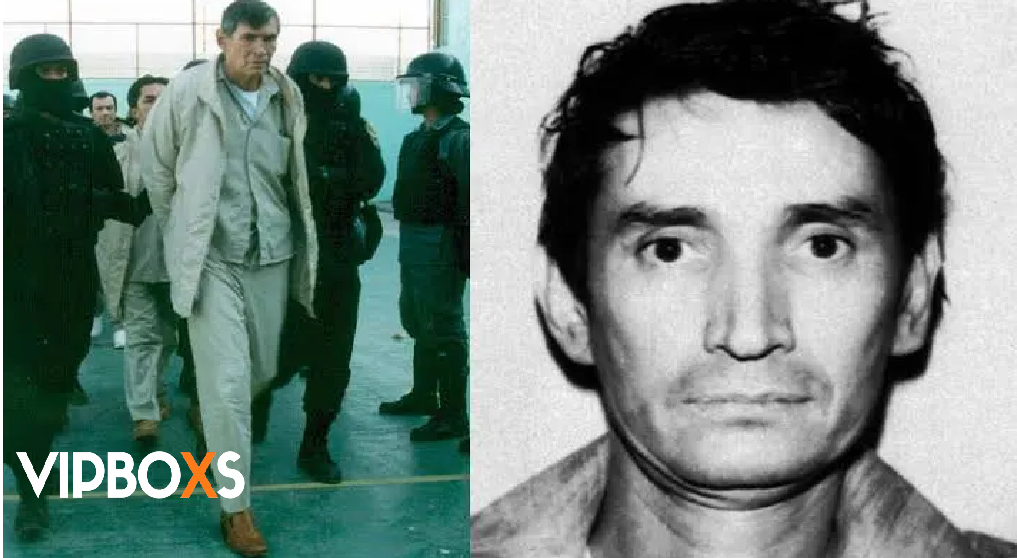
Few names loom as large in the history of Mexican organised crime as Miguel Ángel Félix Gallardo. Once the undisputed head of the country’s drug trade, the octogenarian founder of the Guadalajara Cartel remains a figure of fascination, controversy and, more recently, legal debate over whether his age and failing health should finally see him freed.
Who Is Miguel Ángel Félix Gallardo?
Born on 8 January 1946 in Culiacán, Sinaloa, Félix Gallardo began his working life not as a criminal but as a police officer. It was through this role that he first made contact with the drug-trafficking networks that would come to define his life. He later moved into private security work for wealthy families before pivoting fully into narcotics smuggling in the 1970s.
By the early 1980s, Félix Gallardo had helped establish the Guadalajara Cartel alongside Ernesto Fonseca Carrillo and Rafael Caro Quintero. The organisation quickly became Mexico’s dominant trafficking network, controlling the smuggling routes that funnelled cocaine, heroin and marijuana across the border into the United States. Félix Gallardo is widely credited with negotiating directly with Colombian cocaine suppliers and pioneering the use of commercial aircraft and concealed cargo compartments to move narcotics, innovations that reshaped how cartels operated for decades afterwards.
His influence earned him nicknames that have endured in popular culture ever since: “El Padrino” (The Godfather) and “El Jefe de Jefes” (The Boss of Bosses). He is often described as the architect of the modern Mexican cartel system, having reportedly divided territories among lieutenants who would go on to found the Sinaloa, Juárez and Tijuana cartels after his downfall.
The Camarena Case
Félix Gallardo’s notoriety in the United States stems largely from the 1985 kidnapping, torture and murder of Enrique “Kiki” Camarena, a Drug Enforcement Administration agent operating in Guadalajara. Camarena’s killing, allegedly ordered in retaliation for a major raid on a cartel marijuana plantation, triggered a diplomatic crisis between Washington and Mexico City and became one of the most infamous cases in DEA history. It later formed the basis of the Netflix drama series Narcos: Mexico, in which actor Diego Luna portrayed Félix Gallardo.
He was arrested in April 1989 and has remained behind bars ever since. Félix Gallardo was initially sentenced to 40 years for offences including drug trafficking, arms stockpiling and bribery. In 2017, a Mexican court handed him a further 37-year sentence specifically for his role in Camarena’s murder and the killing of pilot Alfredo Zavala Avelar. He has consistently denied direct involvement in Camarena’s death, telling Noticias Telemundo in a rare 2021 prison interview that he “did not know” the agent and was “not a man of arms.”
Decades Behind Bars and a Long Legal Battle
Now in his eighties, Félix Gallardo has spent more than three decades in some of Mexico’s highest-security prisons, including Puente Grande in Jalisco. For years, his legal team has argued that deteriorating health, reportedly including partial paralysis and severely diminished eyesight and hearing, warrants his release from custody to serve out his sentence at home.
Early applications were unsuccessful. A Mexico City tribunal rejected a bid for home confinement in February 2019, ruling that his medical conditions had not been proven serious enough to justify early release. However, after further appeals citing his advancing age and worsening condition, a federal judge with Mexico’s Seventh District Court for Federal Criminal Proceedings eventually granted him house arrest, allowing him to serve the remainder of his sentence under supervision, reportedly fitted with an electronic monitoring device, rather than in a prison cell.
The ruling did not erase his convictions or his legal obligations. Félix Gallardo is still technically serving two separate sentences, and under Mexican judicial timetables the 37-year term tied to the Camarena case is not due to begin being counted until his first sentence concludes.
A Presidential Pardon on the Table?
The question of Félix Gallardo’s fate has resurfaced at the highest levels of Mexican government. During a recent morning press conference, President Andrés Manuel López Obrador was asked directly whether the ageing capo might be included in a broader decree aimed at releasing elderly and gravely ill prisoners. The president reportedly signalled openness to the idea, saying that if circumstances justified it, Félix Gallardo could indeed be considered for release “because of his age and illness,” though he cautioned that the details of any such decree were still being finalised.
The suggestion has reignited debate in Mexico and the United States over how the country should treat ageing cartel figures whose crimes, though committed decades ago, remain deeply embedded in the public memory. Advocacy groups connected to the Camarena family have previously voiced strong opposition to any softening of his sentence, arguing that his role in one of the most notorious killings of a US federal agent should preclude leniency regardless of his health.
Life After the Cartel
Since his imprisonment, the empire Félix Gallardo helped build has fractured into the rival organisations that now dominate headlines: the Sinaloa Cartel, the Juárez Cartel and others that trace their origins back to his network. Claims about his continued financial influence or a fortune reportedly running into the billions of dollars remain largely unverified and should be treated with caution, given the difficulty of tracing assets tied to a figure imprisoned for over 30 years.
What is clear is that Félix Gallardo’s legacy, as both a pioneer of large-scale narcotics trafficking and a case study in the limits of Mexico’s justice system, continues to shape conversations about crime, punishment and mercy in a country still grappling with the consequences of the cartel era he helped create.
[…] Old Is Jessie Murph? Age & Career Explained Miguel Ángel Félix Gallardo: Mexico’s “Boss of Bosses” and the Fight Over His … Erika Kirk Age: Inside the Life of TPUSA’s New CEO Chiaki Inaba: The Woman Behind One […]